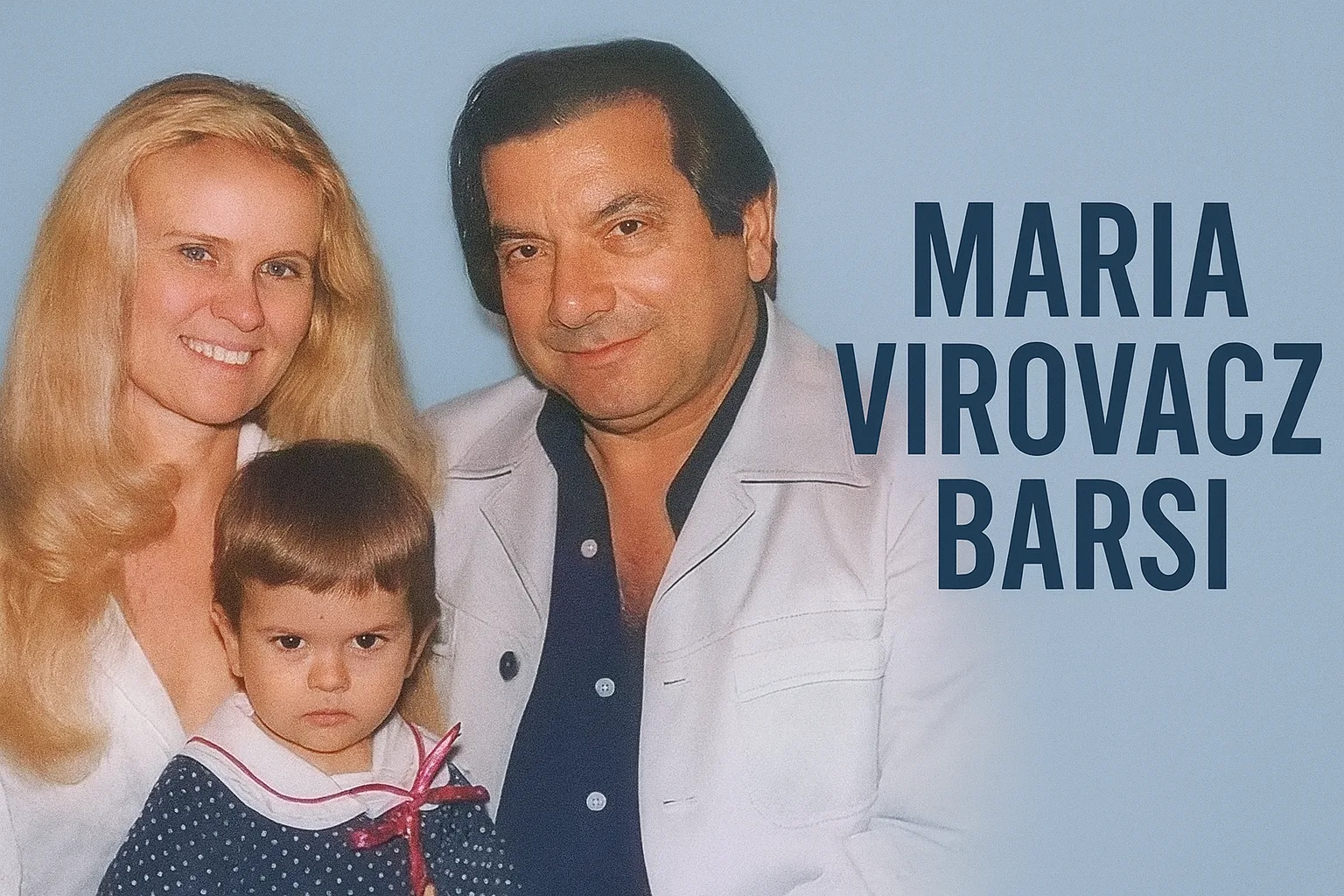
Maria Virovacz Barsi: Tragic Story of Judith Barsi’s Mother
Behind the brilliant lights of Hollywood and the promising profession of young actress Judith Barsi lies a grim and heartbreaking tale of a mother’s love and a family’s ruin.
The mother of the young star, Maria Virovacz Barsi, was the main reason her daughter did so well. She was also a domestic abuse victim who battled till the bitter end to shield her child.
From her early years in Hungary to the horrible occurrences that resulted in Maria Virovacz Barsi and Judith’s premature deaths, this article investigates her life. The tale reminds us sharply of the secret hardships behind a public front and the terrible results of unrestrained violence.
From Hungary to Hollywood
Born on February 14, 1940 in a small university town in southern Hungary, Maria Agnes Virovacz was born She sought a new life in America, like many of her fellow citizens who left the nation after the 1956 Soviet invasion.
Los Angeles-based she waitressed in a Hungarian immigrant-favorite eatery. There she came upon József Barsi, yet another Hungarian refugee from a more challenging industrial region.
József, called “Joe,” was a charming plumber who seemed to be able to give Maria security. She was impressed. They wed in 1977, and Judith Eva Barsi, their sole child, was born on June 6, 1978. From early childhood, Maria worked to mold Judith’s future, fantasizing of a Hollywood career for her daughter.
Guiding a Young Star’s Career
Maria’s effort bore fruit. Judith was found at an ice-skating rink by a commercial team when she was only five years old. They thought she was three years old because she was so small. This random meeting started a very lucrative job. Judith was in over 70 ads for companies including Donald Duck Orange Juice.
Her ability soon landed her more significant parts. Judith got roles on well-known TV shows like Cheers, Growing Pains, and Remington Steele. Additionally she landed parts in big movies including Jaws: The Revenge.
Maria was the archetypal “stage mom,” overseeing her daughter’s career and seeing to it that she had every chance to succeed. Time is nearly passed when With an income of roughly $100,000, Judith, who was in the fourth grade, could afford a three-bedroom home in Los Angeles’ West Hills.
A Family in Turmoil
Life at home was getting worse as Judith’s career took off. As his daughter’s success exceeded his own, József turned jealous and paranoid. Not only physically but also emotionally and verbally, he battled alcoholism and started to get more violent. For Maria and Judith, his threats became a regular cause of anxiety.
Friends and family remembered several horrible events. Sometimes he would say he would kill Maria and Judith both, other times he would leave Maria alive “to suffer” and threatened to kill her.
Maria filed a police complaint in December 1986 alleging József of strangling her, hitting her, and threatening death threats for the past five years. However, the case was dismissed since Maria was reluctant to pursue and there were no apparent injuries.
Judith started to exhibit clear indicators of extreme emotional disturbance. She pulled off her cat’s whiskers and eyelashes. The 10-year-old burst into tears uncontrollably during an audition in May 1988 and was unable to speak.
Ruth Hansen, Maria’s agent, made sure Maria saw a child psychologist. The therapist found “extreme verbal, mental, and emotional problems” and sent the case to the Los Angeles County Department of Children’s Services.
A System That Failed
The system failed to safeguard the Barsi family despite several cautions and explicit warning indicators. Maria informed caseworkers she had a scheme to leave József and had even found a flat in Panorama City.
She stayed days there with Judith but came home at night, not eager to lose the house her daughter’s job had purchased. Once Maria said she was managing the matter, the Children’s Services case was closed.
Maria appeared unable to complete the last separation even as friends and neighbors offered assistance. She pushed off her trip because she was attached to their home in July and Judith’s birthday was in June. Fear and abuse kept repeating themselves, eventually reaching a terrible and unavoidable conclusion.
A Horrific End
József Barsi followed through on his threats on the evening of July 25, 1988. Judith was shot in bed as she slept. Maria ran to stop him when she heard the gunshot, but he shot and killed her too.
He resided in the home with his wife’s and daughter’s bodies for two days. He poured gasoline on their bodies, set the house on fire, and then went to the garage where he shot himself in the head and ended his life on July 27.
Hearing the loud explosion from the fire, a neighbor phoned for assistance. That day later the corpses were found. At 48 years old, Maria Virovacz Barsi had a 10-year-old daughter named Judith.
The Legacy of Maria and Judith Barsi
Maria Virovacz Barsi and Judith Barsi were buried side by side at the Hollywood Hills’ Forest Lawn Memorial Park. People who remember the brilliant, gifted child and the mother who tried to protect her come to visit their shared grave, which is a sad landmark.
Maria’s gravestone bears the words “Wind Beneath JEB’s Wings,” which honors her encouraging part in the brief life of her daughter. The story of Maria and Judith Barsi is a horrible illustration of how domestic violence may destroy lives.
It emphasizes the flaws of a system that found it difficult to interfere in situations of emotional abuse and a mother’s pathetic but finally lethal reluctance to flee an abusive surroundings. In cases of child abuse, their deaths sparked demands for increased knowledge and better intervention plans.
A Story of Love and Loss
Maria Virovacz Barsi’s life was one of hope, desire, and finally disaster. She fantasized of a better life for her daughter, and for a moment it seemed she had realized it. Still, they were devoured by the darkness in her own house.
Her narrative is a forceful reminder that fighting domestic abuse calls for bravery, support, and definite action. Remembering Maria honors a mother’s great love and helps us to consider the institutional reforms required to shield at-risk families from such circumstances.
Conclusion
The narrative of Maria Virovacz Barsi and her daughter Judith is a gut-wrenching reminder of the terrible results of unbridled domestic abuse. Their tragedy highlights the need of vigilance, knowledge, and strong support systems for those who have been abused.
Sharing their narrative aims to highlight the red flags of domestic violence and encourage others to act before it is too late by means of which we hope to illuminate. May their example inspire understanding, empathy, and significant action in the continuing struggle to safeguard needy households.
1. Who was Maria Virovacz Barsi?
Child performer Judith Barsi had Maria Virovacz Barsi as her mother. Born in Hungary in 1940, she came to America following the 1956 Soviet invasion. Despite terrible domestic abuse, she worked nonstop to develop her daughter’s Hollywood career.
2. How did Judith Barsi begin her acting career?
Judith’s acting career was initially a matter of fate when she got noticed at an ice-skating rink. Her slight build contributed to her looking younger, and this worked to her advantage in getting commercial parts. She ultimately acted in more than 70 commercials and in significant television and movie productions.
3. What kind of abuse did Maria and Judith face at home?
They were subjected to a long-term period of emotional, verbal and physical abuse by Jozsef Barsi, the husband of Maria and the father of Judith. He often threatened violently, was alcoholic and created an atmosphere of terror in the house.
4. Did authorities intervene in the Barsi family situation?
In numerous reports on abuse, they were reported by the police and a psychologist. Despite Maria’s intention to leave, the case was then later closed since she claimed that she was in control of the situation. After all, they were not safeguarded by the system.
5. What happened to Maria and Judith Barsi?
In numerous reports on abuse, they were reported by the police and a psychologist. Despite Maria’s intention to leave, the case was then later closed since she claimed that she was in control of the situation. After all, they were not safeguarded by the system.